

Why Artists and Potters Prefer Leather Aprons
Most artists do not think much about their apron. It is the piece of old clothing hanging on the studio door, stiff with years of dried acrylic, or so saturated with clay slip that it could stand up on its own. It does the job. It is not something you replace until it disintegrates.
Then something shifts. Maybe it is a visit to someone else's studio, where the person at the wheel or the easel is wearing something that looks deliberately chosen. Maybe it is the tenth time in a year that acrylic has soaked through the canvas and ruined a good shirt underneath. Maybe it is simply the realization that the studio is a serious place, and the workwear should reflect that.
Whatever the trigger, more painters, potters, ceramicists, sculptors, printmakers, and studio makers are switching to leather aprons, and the reasons are more practical than aesthetic, even when the aesthetic is what first catches the eye.
The specific problems artists and potters face
To understand why leather works well in a studio context, it helps to be honest about what creative work actually puts an apron through.
Paint does not behave the way people assume
Acrylic paint is water-based and easy to clean when wet. When dry, it is essentially plastic; it bonds to fibers, builds up layer by layer, and does not come out in a wash. After a year of active use, a canvas or cotton apron carries every session on its surface. The fabric stiffens. The acrylic flakes eventually. You are essentially wearing a record of every painting decision you made, which sounds poetic but in practice means a heavy, uncomfortable garment that smells of paint medium.
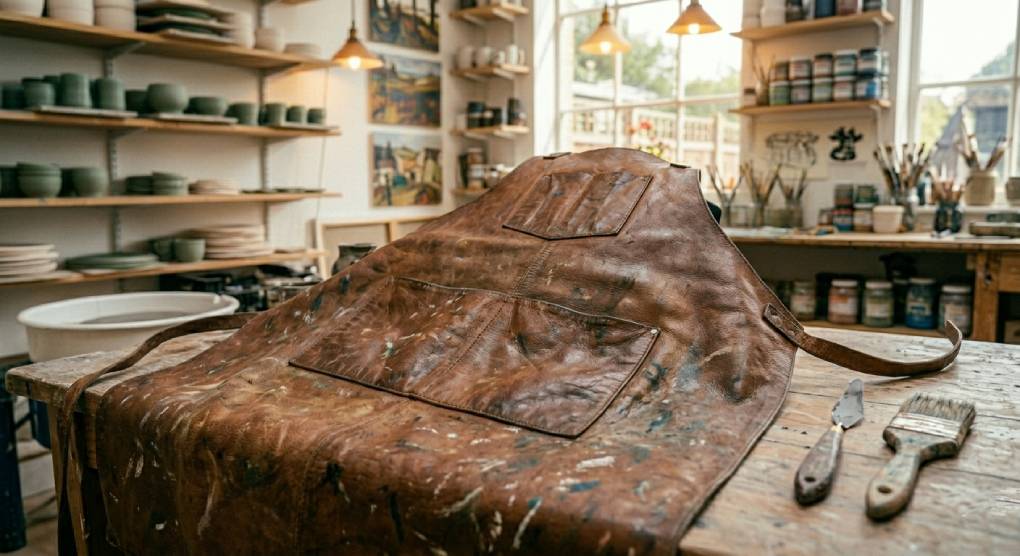
Oil paint is slower to dry and slower to penetrate, but it does penetrate, and paint medium, linseed, stand oil, and turpentine saturate fabric permanently. A canvas apron used for oil painting is, within a few months, an oil-saturated rag that carries a strong smell into every session.
Leather does not absorb paint in the way fabric does. Acrylic and oil paint sit on the surface. Wiped while wet, most of it lifts cleanly. Left to dry, it does not bond into the fibers; it sits on top of the surface and can be peeled or scraped away without damaging the leather underneath. After years of use, a leather painting apron carries a patina of accumulated color rather than a rigid shell of embedded paint, and it remains flexible throughout.
Pottery and ceramics are harder on workwear than most people realize
Clay is abrasive. The slip that coats your hands and forearms during throwing, trimming, and hand-building reaches everything: tools, surfaces, your clothing, and the apron. It dries into a fine dust that works into the weave of fabric and is genuinely difficult to remove completely with washing.
The physical demands of wheel work are also different from most studio practices. You are leaning forward for sustained periods, reaching across a spinning bat, applying pressure with your whole body. The apron bunches, pulls, and shifts. A lightweight canvas apron that sits comfortably at an easel becomes a liability at a throwing wheel, slipping, catching the rim of the bat, or simply getting in the way.
Leather sits differently. Its weight and structure mean it stays in place rather than shifting with every movement. The surface resists clay absorption better than any fabric. And because leather does not develop the fine clay-dust saturation that fabric does, it does not contribute to the respiratory irritation that some potters notice in enclosed studios where dry clay dust accumulates.
Solvents, glazes, and resins
Beyond paint and clay, studio practice often involves materials that are genuinely hard on workwear. Glaze materials for ceramics. Resin for encaustic work or sculpture. Solvent-based varnishes and mediums. Printmaking inks and mordants. Screen-printing chemicals.
None of these is fully held by leather; the apron is not a chemical barrier suit, but leather resists them considerably better than canvas or cotton. Surface contact with most studio chemicals can be wiped away before it penetrates. Solvent splashes on canvas work immediately and permanently into the fibers; on leather, you have time to wipe.
Why leather works in a creative studio
It does not absorb the way fabric does
The core property that makes leather perform well across all studio disciplines is the same one: its surface is closed and non-porous in a way that natural and synthetic fabrics are not. Liquid sits on leather. It soaks into fabric.
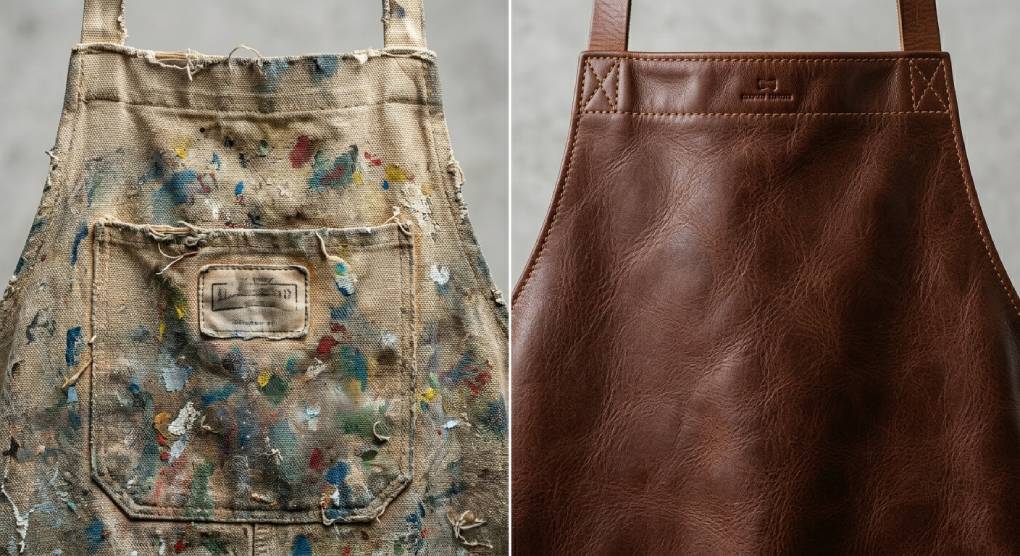
This has cascading practical effects. The apron is easier to clean after each session. It does not build up residue the way fabric does. It does not carry smell from session to session in the way an oil-saturated canvas does. After years of use in a working studio, a leather apron looks lived-in rather than degraded.
It lasts without degrading
A canvas studio apron in regular use lasts two to three years before the fabric starts to break down, either from paint rigidity, solvent degradation, or simple wear at the pockets and strap attachments. Many artists go through a canvas apron every year.
Cowhide leather in the same conditions lasts significantly longer; seven to ten years is not unusual with basic maintenance. The per-year cost of a leather apron is lower than replacing canvas repeatedly. And leather does not degrade in the way canvas does: it does not thin, tear, fray, or lose structural integrity under normal studio conditions.
It looks right in a serious studio
This is not a vanity argument. The studio is a working environment, and how that environment looks affects how you approach the work in it. Artists who have put thought into their space, the light, the storage, the surfaces, the tools, usually find that a well-made leather apron fits that environment in a way a worn canvas one does not.
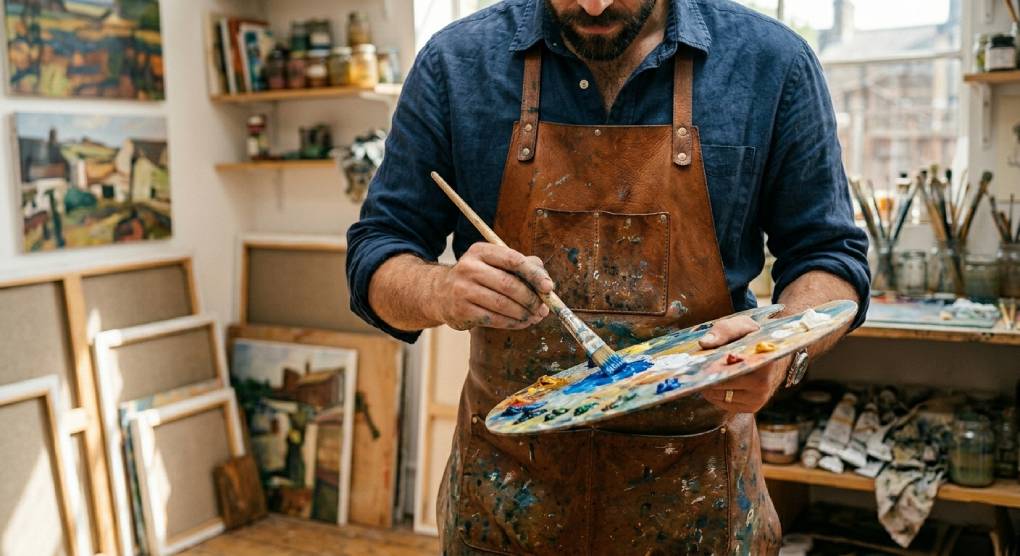
It also matters in contexts where the studio is visible to others. Open studios, teaching environments, gallery events where the artist is present and working, and commission visits. A leather apron communicates the same thing that good tools communicate: that the person wearing it takes the craft seriously.
It is part of a growing maker aesthetic
There is a broader shift happening across trades and creative disciplines toward tools and workwear that are made well, built to last, and carry meaning beyond their function. It is visible in the craft beer industry, in artisan food production, in furniture making, in ceramics, and the leather apron is part of that visual language, and artists and makers have noticed.
This is not separate from the practical reasons. For most people who make the switch, the practical case is what justifies the decision. The aesthetic is what makes it feel right.
What to look for in a leather artist apron
Coverage for your specific discipline
The right coverage depends on where your work concentrates the mess.
Painters working at an easel tend to get more on their chest and upper torso, paint from loaded brushes, palette contact, and accidental drips from raised work. A full bib that extends above the waist is important. The lower half matters less, which makes a shorter or lighter cut comfortable for standing work over long sessions.
Potters at the wheel need coverage across the whole front. Clay and slip travel from the bat upward across the torso and downward across the legs during wedging and throwing. A full-length bib apron is the practical choice. Length to the knee protects your lap during seated throwing.
Printmakers and screen printers work in environments with splash risk from inks, mordants, and chemicals. Full coverage and a close body fit that does not drape over the work surface are both important.
Sculptors and mixed-media makers move around more and work in more varied positions than most other studio disciplines. Here, the strap system matters as much as coverage, something that stays in position across a wide range of movement, without riding up or shifting when you are working overhead or crouching.
Pocket layout for studio tools
The tools an artist carries are different from those a chef or woodworker carries. They are lighter and more varied: brushes, palette knives, pencils, a phone, a sponge for pottery, tool handles, and a water spray bottle. The pockets need to reflect this.
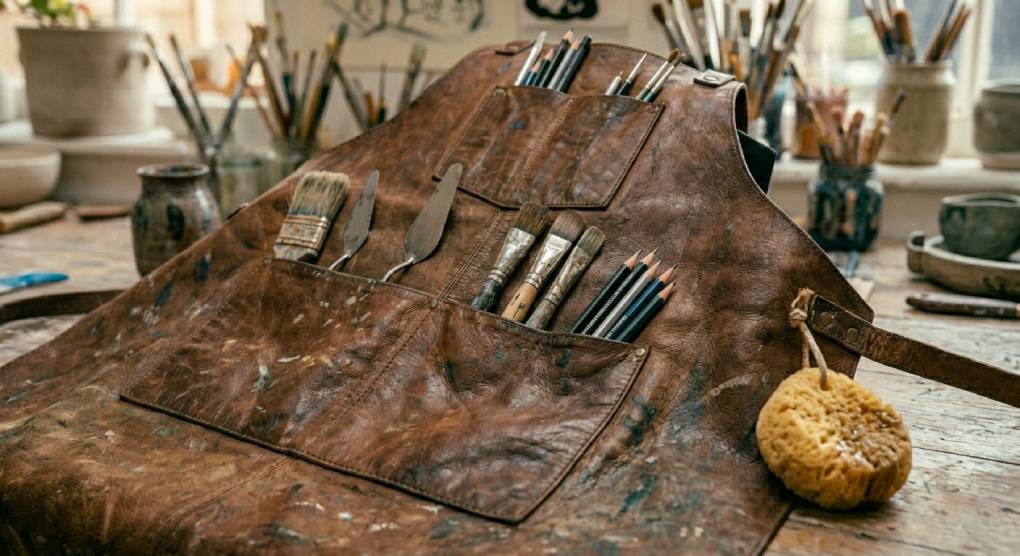
Look for:
- Multiple narrower pockets that hold individual tools upright, rather than one large pocket where everything rattles together and scratches against other tools
- At least one pocket wide enough for a folded sketch or reference printout
- A loop or ring for hanging a damp sponge or spray bottle without it sitting in a pocket and wetting everything else
- Pockets positioned low enough that they do not interfere with forward reach at a wheel or easel
Avoid pockets with internal fabric lining in a studio context; paint and glaze work into lining material more readily than into leather, and lined pockets become a cleaning problem.
Strap system for extended creative sessions
Studio work often involves long, uninterrupted sessions, several hours of continuous work in a state of focus that you do not want the apron interrupting. The strap system should disappear into the background.
Cross-back (H-back) straps distribute the apron's weight across both shoulders and the upper back. There is no loading at a single point on the neck, which matters particularly for potters who spend long sessions leaning forward at the wheel. The straps also stay in place as you move; they do not shift onto your upper arms when you reach forward or ride up when you crouch.
Adjustable brass buckles let you set the fit precisely and return to it every session. For studio work where you may layer clothing underneath in winter, enough strap length range to account for a thick jumper is worth checking.
Color and how it wears in the studio
Brown leather is the most forgiving color for studio use. The warm tones of cowhide absorb the visual record of accumulated work gracefully: the trace of acrylic, the ghost of clay, the darkening from oil and conditioning. A brown leather apron at the end of ten years in a working studio looks better than it did new, in the way good tools always do.
Black leather hides surface marks well too, but shows dried clay dust and dried paint flakes more visibly against the dark background. Orange and tan leather is striking in a studio context and photographs well for artists who document their practice, but shows surface marks more readily.
For artists who want to add their name, their studio name, or a personal mark to the apron, laser engraving on a mid-brown cowhide gives the clearest contrast and the most legible result.
Leather aprons as a gift for artists and makers
A leather artist apron sits in a particular gifting category: it is something a serious maker would genuinely love and would almost certainly never buy for themselves. The reasoning is usually cost: "I can make do with what I have, even when what they have is a paint-saturated canvas bib that has been hanging in the same spot for six years.
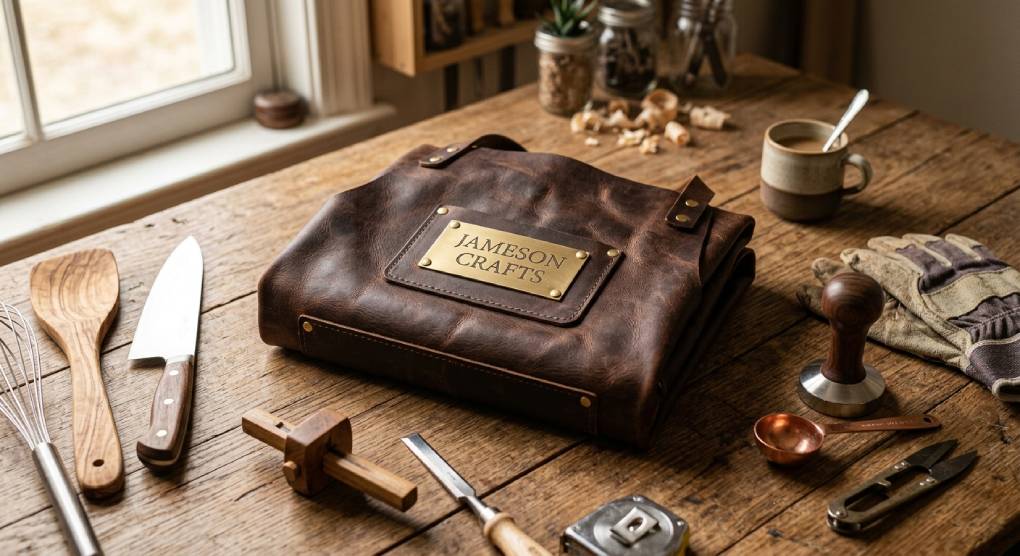
It works well as a gift for:
Art school graduates and emerging artists setting up their first proper studio. Alongside good brushes or a quality palette, a leather apron marks the beginning of taking the practice seriously.
Potters and ceramicists who have been wearing a recycled cotton shirt for years and have never thought to replace it with something built for the purpose.
Printmakers and mixed-media artists whose studio practice involves a wide range of materials and who would benefit from something genuinely resistant rather than merely absorbent.
Artists with an open studio or teaching practice where the apron is visible to students and visitors, and where looking considered about your workspace matters.
Birthdays, Christmas, and significant creative milestones, finishing a series, opening a studio, and completing an artist residency.
Personalization through Lapron's engraving and embossing service adds a name, studio name, initials, or a short phrase to the front of the apron. For a gift context, this turns a practical item into something made specifically for that person, which is almost always what separates a memorable gift from a functional one.
Caring for a leather apron in a studio environment
Studio use is relatively gentle on leather compared to trades like butchery or blacksmithing. The main maintenance tasks are straightforward.
After each session
Wipe the surface with a clean damp cloth while paint, clay, or other materials are still fresh. Most studio materials come away easily when wet; the same acrylic that bonds permanently to canvas wipes off leather cleanly before it dries. For oil paint, a cloth with a small amount of linseed oil or a purpose-made leather cleaner lifts the residue without stripping the leather's surface.
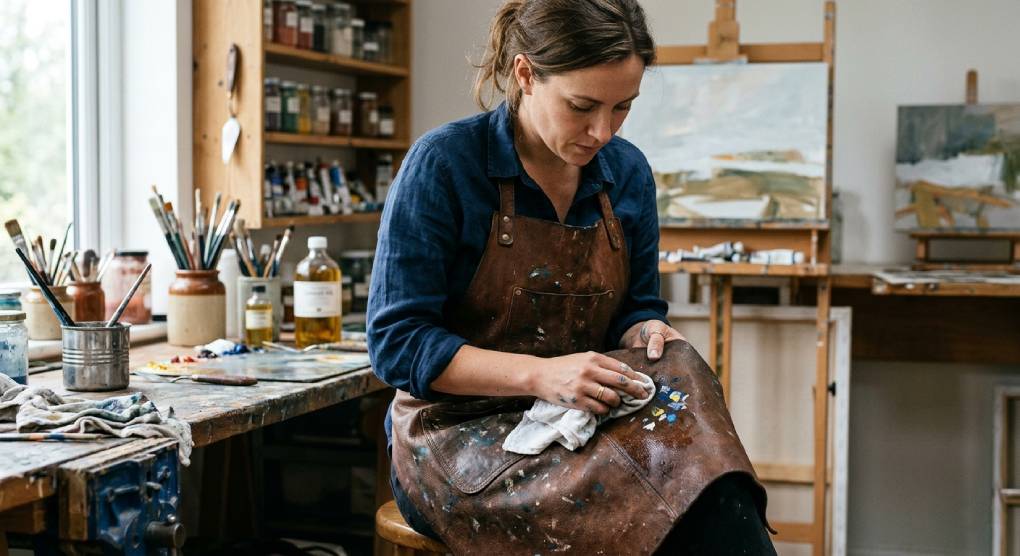
Dried acrylic can be removed with gentle peeling or a soft edge; it does not bond into the leather's grain the way it does into canvas fibers.
Monthly conditioning
A leather conditioner applied once a month keeps the surface supple and prevents the drying and eventual cracking that comes from repeated cleaning without conditioning. Apply to the areas that flex most: the fold at the waist, around the armholes, along strap attachment points. Allow it to absorb and buff lightly with a clean cloth.
Artists who work with solvents regularly should be aware that turpentine and mineral spirits can strip natural oils from leather with repeated contact. Conditioning more frequently, every two to three weeks, offsets this.
What to avoid
Do not hang a leather apron near a kiln or any heat source. The combination of high ambient temperature and low humidity dries cowhide more rapidly than normal studio conditions. Keep it away from direct sunlight when stored, and hang it rather than folding it; folding in the same place repeatedly creates a crease line that eventually becomes a stress point.
For a full care and conditioning guide, see Cleaning and Caring for a Leather Apron.
Lapron's leather artist apron collection
Lapron makes four leather artist aprons, each designed for studio and creative use. All are made from 100% genuine cowhide leather with solid brass hardware and adjustable cross-back straps. Every apron is available with custom laser engraving.
Canvas Keeper Artist Apron, $165–$238
A clean, practical design built for painters and mixed-media artists. Full bib coverage, multiple pockets for brushes and tools, brass hardware throughout. The most accessible entry point in the artist range, a strong first leather studio apron that works equally well for painting, drawing, and printmaking.
Painter's Pride Leather Apron, $168–$240
Designed specifically for painters. 100% genuine cowhide with brass accents and an ample pocket layout that keeps brushes and palette knives in specific places rather than loose in a single pouch. Adjustable straps with enough range for layered clothing in a winter studio. The name is on the nose; this is an apron for someone who takes their painting practice seriously.
Premium Canvas Crafter Artistry Apron, $189–$265
A step up in coverage and finish. Full front coverage with a wider cut that suits potters and sculptors as well as painters. The pocket layout is the most considered in the range for studio use, with narrow individual pockets that keep tools separated rather than letting them knock against each other. The heavier cowhide holds its structure better during extended physical sessions at the wheel.
Artistry Craft Leather Apron, $250–$405
The flagship in the artist collection. Distinctive orange cowhide with brass accents throughout, a strong aesthetic statement in a studio environment, and equally practical as any apron in the range. The widest coverage in the collection. Suited to artists who want their workwear to reflect the visual personality of their practice, and to makers who work across multiple disciplines. An exceptional gift for a serious artist.
Choosing the right one
|
Your practice |
Recommended apron |
Price from |
|
Painting, first leather studio apron |
Canvas Keeper |
$165 |
|
Dedicated painting studio work |
Painter's Pride |
$168 |
|
Pottery, ceramics, or mixed studio practice |
Canvas Crafter |
$189 |
|
Statement piece or premium gift for an artist |
Artistry Craft |
$250 |
Not sure which suits the specific practice you are buying for? Email support@leatherapron.shop and we will give you a direct recommendation.
A final thought on why it matters
The studio is one of the few places where how you spend your time is entirely self-directed: no brief, no schedule, no performance metric except the work itself. The tools and environment you build around that time are worth thinking about carefully.
Most artists give enormous thought to their materials, their light, their storage. The apron is often the last thing to get that consideration. It probably deserves more than it gets.
Leather is not the only answer. But for the specific combination of protection, durability, surface behavior with studio materials, and the way it looks after years of real use, it is a difficult one to argue against.