Most gardeners treat their apron as an afterthought. They grab whatever is hanging by the back door, a frayed cotton bib, a waxed canvas half-apron that lost its waterproofing two seasons ago, and get on with the work.
Then they try a leather gardening apron. And it changes how they think about every hour they spend outside.
This guide covers what makes leather the right material for serious gardening, which features actually matter when you are kneeling in a border, pruning a rose hedge, or hauling compost across a lawn, and how to pick the right apron for the way you garden. There is also a section on gifting, because a leather gardening apron is one of those rare gifts that a gardener would never quite justify buying for themselves, and that they will use for the rest of their life.
Why leather works so well in the garden
The garden is a harder environment for workwear than most people realize. You are dealing with thorns, rough bark, sharp tool edges, wet soil, grass stains, plant sap, UV exposure, and wide temperature swings, sometimes within a single morning. Most apron materials handle some of these well. Leather handles all of them.
Thorn and abrasion resistance
This is where leather has no real competition. Cowhide at 1.2mm to 1.6mm thickness resists the kind of puncture and dragging force that rose thorns, brambles, hawthorn, and beriberi's apply to your clothing. A cotton apron keeps some dirt off your clothes. It does not stop a two-centimeter thorn from going straight through.
For gardeners who work with roses, climbing plants, or hedging, this protection is not cosmetic. A thick leather bib keeps your forearms and torso genuinely safe during pruning and training, in a way that canvas or cotton simply does not.
Soil and moisture resistance
Garden soil, especially after rain or watering, is heavy and wet. It soaks into fabric within minutes. By the end of a morning's planting session, a cotton or canvas apron can weigh considerably more than it started, and it carries that soil back indoors with you.

Leather repels surface moisture. Mud and wet soil sit on it rather than soaking in. A shake and a wipe and most of it is gone. For gardeners who move between the garden and the house, picking vegetables for the kitchen, carrying cuttings indoors, working in the greenhouse, this is a significant practical difference.
Plant sap and staining
Many plants release sap when cut, euphorbia, fig, ivy, and numerous others produce sap that stains fabric permanently and, in some cases, irritates skin. Leather does not absorb sap in the way fabric does. It can be wiped clean quickly, before the sap has time to set.

The same applies to grass stains, compost, and the inevitable marks that come from kneeling on soil, resting tools against your front, or brushing against a painted fence mid-garden.
Durability across seasons
A good fabric gardening apron lasts two or three seasons before it degrades visibly, the material thins, the pockets tear, the straps fray. A well-maintained leather gardening apron can last ten to fifteen years.
For gardeners who spend serious time outdoors, that longevity changes the economics entirely. The upfront cost is higher. The cost over time is considerably lower. And unlike a worn-out fabric apron, leather does not look tired, it develops a patina that reflects years of use in the best possible way.
Features that matter in a leather gardening apron
Not all leather aprons are designed with gardening in mind. Some features that matter in a kitchen or workshop are irrelevant in the garden. Others that you might overlook in a product listing make a real difference when you are actually using it.
Pocket number, size, and placement
This is the feature most worth scrutinizing before you buy, because getting it wrong is genuinely frustrating.

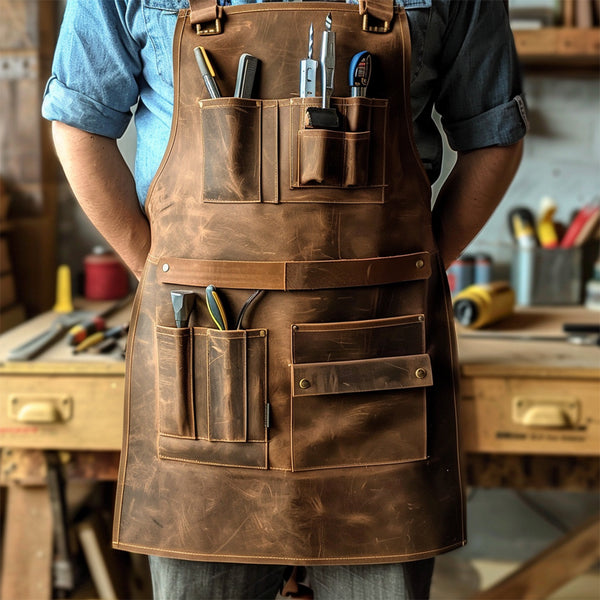
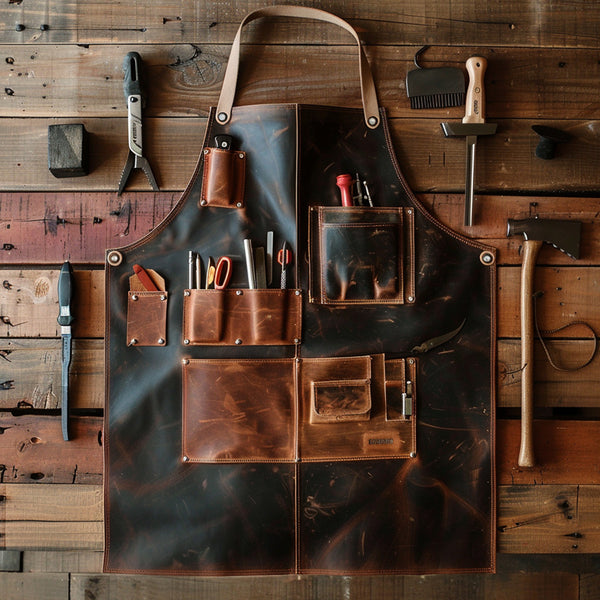
The tools a gardener carries are varied in size and shape, secateurs, a hand trowel, a fold-up pruning saw, seed packets, plant labels, a ball of twine, gloves, a phone. A single large pocket means everything rattles around together. Small, shallow pockets mean you cannot fit a trowel handle without it falling out every time you bend forward.
What works well for gardening:
- At least four to six pockets of mixed sizes
- One wide, deep pocket for a hand trowel or folding saw, deep enough that the handle does not protrude above the pocket edge
- Narrower pockets for secateurs, plant labels, and a pen, ideally with a slight inward angle so items do not fall out when you crouch
- A loop or ring for twine or a kneeling pad strap
- A large open pocket on one side for seed packets, a phone, or a folded-up harvest bag
Reinforced pocket corners are worth checking too. This is where cheaper leather aprons fail first, the constant weight of tools in pockets concentrates stress at the pocket base and corners, and thin or poorly stitched seams give way.
Strap system for outdoor movement
Gardening involves a much wider range of motion than most professional trades. You are bending forward to plant, twisting to reach past a shrub, kneeling, crouching, reaching overhead for tree branches, and walking considerable distances across uneven ground. The strap system needs to accommodate all of this without riding up, tightening uncomfortably, or shifting the apron out of position.

Cross-back (H-back) straps perform significantly better than neck straps for active garden work. They sit across your shoulders rather than hanging from your neck, which means:
- No neck pressure during extended periods of bending forward
- The apron stays centered as you twist and reach
- The weight is distributed evenly, so a pocket full of tools does not drag the whole apron to one side
Adjustable brass buckles on the straps allow you to set the fit precisely and keep it there. Plastic adjusters work initially but loosen over time with repeated tension and release.
For gardeners who layer up in cooler months, a fleece under a waterproof jacket, for example, the ability to adjust strap length matters more than it does in summer. Make sure the apron you choose has enough strap range for your thickest working outfit.
Length and coverage
Half-aprons (waist down) suit some garden tasks well, harvest work, light planting, greenhouse tasks where you are standing most of the time. For thornier or dirtier work, full bib coverage is worth having. A bib that extends to the knee gives you protection when kneeling against a border edge and shields your torso from plants that scratch or drip sap at chest height.
The right length for you depends on your height and the kind of gardening you do. As a rough guide: if you primarily do light planting and harvest work, a half-apron works. If you regularly prune, dig, or work with brambles and roses, choose a full-length bib apron.
Color, and why it matters outdoors
Brown leather ages particularly well in the garden context. It hides soil marks better than black leather, and the natural patina development suits the outdoor setting. Black leather looks very good when new but shows light-colored soil dust and dried mud more visibly.
Both are practical choices. If you plan to personalize the apron with engraving, a name, a garden name, an occasion date, a medium-brown cowhide tends to give the best contrast and legibility on the engraved text.
Fit, getting it right for men and women
Leather gardening aprons are worn by gardeners of all builds, and a well-made apron should fit comfortably regardless of whether you are broader across the shoulder, shorter in the torso, or anything else.

For men: Lapron's gardening aprons are sized from Small to 2XL across the full range. Most men find that sizing to waist measurement works well, if you are between sizes, size up to ensure the apron covers your torso fully when you lean forward.
For women: Cross-back straps adjust independently, so the fit around the shoulders can be dialed in without affecting the waist or body coverage. The Tera Craft and Rustic Craft aprons have a slightly narrower cut that fits closer to the body, which many women find more comfortable than the wider silhouette of a standard bib apron.
If you are buying as a gift and are unsure of size, note that the cross-back strap system is forgiving enough to cover a size difference in most cases. If in doubt, our size guide covers measurements in detail, and you are welcome to email support@leatherapron.shop for a recommendation based on the recipient's height and build.
Leather gardening aprons as gifts
This is worth its own section, because it reflects how a significant portion of our gardening aprons are actually bought.

A leather gardening apron sits in a specific gifting niche: it is practical enough that the recipient will use it for years, premium enough that it feels like a real occasion gift, and personalized enough, especially with engraving, to feel genuinely considered rather than generic.
It works well as a gift for:
Passionate gardeners who have been making do with a canvas apron for years and would never spend this much on themselves. They see the cost and decide they can manage with what they have. Someone else buying it for them removes that hesitation.
New allotment holders or garden owners who are just building their tool kit. A leather apron alongside a good pair of secateurs is a better gift than another set of seed packets.
Retirement gifts for someone who has spent forty years saying they will get more time in the garden. A leather apron with their name engraved on it, and a date, makes the gift specific and meaningful.
Mother's Day, Father's Day, and Christmas for the parent or grandparent who has everything and spends most of their weekends outside.
Personalization options through Lapron's engraving and embossing service include a name, initials, a short phrase, a date, or a logo. The engraving is laser-cut into the cowhide and does not fade or wear off. For a gifting context, it transforms a very good practical item into something that feels made for that specific person.
How to care for a leather gardening apron
Outdoor use means the apron picks up more moisture and organic matter than an apron worn in a kitchen or workshop. The care routine needs to reflect that.

After every session
Brush off loose soil before it dries hard. Dried clay soil in particular can abrade the leather surface if it is rubbed rather than brushed away. A soft brush or a slightly damp cloth removes most of it easily.
If the apron has been in rain or heavy dew, hang it somewhere dry and well-ventilated, not near a radiator or in direct sunlight. Drying leather slowly and at ambient temperature prevents it from stiffening or cracking.
Every few weeks during active use
Apply a leather conditioner to any areas that have been in regular contact with moisture, the lower front where you rest tools and kneel against borders, and around the strap attachments where flexing concentrates. Cowhide that stays conditioned remains supple and flexible; cowhide that dries out becomes stiff and eventually cracks at stress points.
Use a conditioner formulated for cowhide or general purpose leather, not petroleum-based products, which can darken the leather unevenly and degrade the stitching over time.
Seasonal storage
At the end of the main gardening season, if you are someone who puts the apron away over winter, clean the apron thoroughly, condition it, and store it folded or hung in a cool dry place away from direct light. Leather stored damp develops mold, and leather stored in sunlight fades unevenly. Both are avoidable with basic care.
For a detailed guide to cleaning and conditioning leather, see Cleaning and Caring for a Leather Apron.
Handling plant sap
Some plant saps set quickly on contact with air. If you notice sap on the apron during work, wipe it off with a damp cloth before it dries. Dried sap is harder to remove but usually responds to a small amount of saddle soap applied with a damp cloth, followed by conditioning once dry. Avoid solvent-based cleaners, they remove the sap but also strip the leather's natural oils.
Lapron's leather gardening apron collection
Lapron makes six leather gardening aprons designed for outdoor use in all conditions. All are made from 100% genuine cowhide leather with solid brass hardware. Every apron in the range is available with custom laser engraving.
Rustic Craft Leather Gardening Apron, $135–$199
The most accessible entry point in the gardening range. Durable cowhide, adjustable straps, practical pocket layout. A solid first leather gardening apron for anyone making the switch from canvas.
Waterproof Terra Craft Garden Apron, $173–$239
Built for wet-weather gardening. The cowhide has been treated for enhanced moisture resistance, making it the strongest option in the range for gardeners who work in all weathers. Adjustable cross-back straps and a wide pocket layout.
Garden Guru Leather Apron, $215–$305
Premium cowhide with a full bib cut and extended front coverage. Designed for gardeners doing regular pruning, digging, and border maintenance, tasks that involve sustained contact with soil, thorns, and rough bark. The widest pocket arrangement in the mid-range.
Plant Master Garden Apron, $239–$319
A heavier cut with reinforced stitching throughout. Built for serious gardeners and professional horticulturalists who need an apron that performs across a full working week, season after season. Brass hardware throughout, adjustable at every strap point.
Earth Artisan Garden Apron, $235–$315
The most pocket-forward option in the range. Designed specifically for gardeners who carry a wide range of tools, trowels, secateurs, labels, seed packets, folding saws, and want everything in a specific place. Excellent as a gift for organized, serious gardeners.
Bloom Belt Leather Apron, $245–$329
The flagship in the gardening collection. Heaviest cowhide, the widest coverage, and the most considered pocket layout. Built to last decades with proper care. If you are buying once and buying for life, this is the one.
Browse the full collection: leatherapron.shop/collections/gardening
Choosing the right one
If you are still deciding, here is a simple way to think about it:
- Starting out or gifting on a budget: Rustic Craft ($135–$199), excellent quality at the most accessible price
- Wet climate or all-weather gardening: Terra Craft ($173–$239), treated for moisture resistance
- Regular pruning and border work: Garden Guru ($215–$305), best coverage for thorn-heavy work
- Carrying lots of tools: Earth Artisan ($235–$315), the most practical pocket layout in the range
- Premium gift or long-term investment: Bloom Belt ($245–$329), the best leather, the best finish, built to last
If you are unsure which suits your gardening style, email support@leatherapron.shop and we will point you in the right direction.
The longer view
Most gardening purchases are consumable, seeds, compost, bulbs, seasonal plants. You buy them and they are gone. A leather gardening apron is one of the few things you buy for the garden that genuinely lasts, improves with time, and becomes part of how you work.
The right one, bought once and cared for properly, will still be in use when whatever you planted the season you bought it is fully established. That is a reasonable standard for a piece of workwear. Very few materials meet it. Cowhide leather does.
This article is authored by Shahzada Umer Farooq.